The Moon in the Yellow River by Denis Johnston


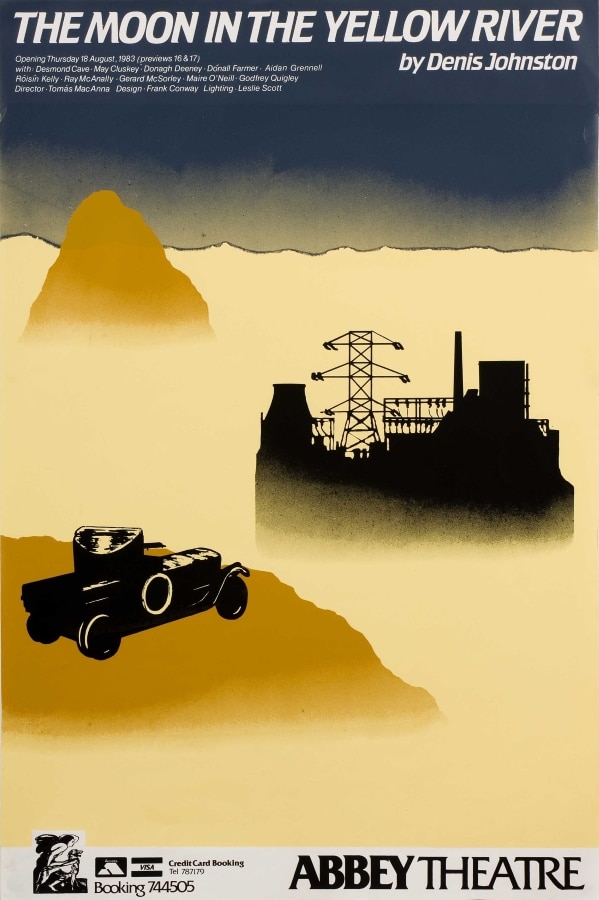
The Moon in the Yellow River by Denis Johnston focuses on the IRA’s 1927 attempt to destroy a government-owned power plant in the Irish Free State. The play directly addresses Irish history through a specific event rather than via conceptual cultural issues like in Brian Friel’s Translations. The poster for The Moon in the Yellow River is more specific and directly related to the event it discusses than that for Translations, which featured more metaphorical imagery to explore the play’s event. The poster features the power plant in a central position, directly conveying the play’s central event to the audience. This running of the play opened on August 18th, 1983 and had a twenty-three show run in Dublin’s Abbey Theatre.
The Moon in the Yellow River first premiered in 1931 with themes of violence and peace being discussed. An article in The Irish Press from 1970 explored the relevance of this as it was only a couple of years following the Irish civil war. This was also just a few years ahead of Hitler’s rise to power, which resulted in the Second World War. Another article from the Irish Independent discussing the 1983 revival of the play in the Abbey Theatre conjectures that the original play’s themes are no longer as directly relevant, but notes a shift in the productions’s focus to accommodate this by expanding to encompass the global issue of industrialisation. This implies that there is an obligation for theatre to directly relate to society of the day, which further indicates the poster’s use for understanding the society of the day. The poster certainly suggests an emphasis on industrialisation with the power plant’s prominent position in the artwork.
It is also intriguing that the poster – perhaps following the lead of the play – does feature the power plant so prominently, as it is arguable that the themes of violence and peace that were central to the play’s initial production were still of relevance in 1980s Ireland. At the time, Northern Ireland was experiencing the conflict known colloquially as the Troubles. This was a conflict that lasted around thirty years and claimed the lives of roughly 3,000 people. Whilst Johnston wrote the play prior to this particular conflict, its themes of violence, division, and nationalism were relevant to a conflict occurring on the island of Ireland. However, there was some apathy regarding the conflict in Northern Ireland from those living in the Republic of Ireland. A survey of those living in the Republic of Ireland in 1988 indicated that 49% of respondents believed that Northern Ireland and the Republic of Ireland were two different states. Therefore, the lack of reference to the conflict in the poster, and indeed this production of the play, could be indicative of that perceived distance from the Troubles from those in Dublin. This creates an interesting dynamic in which the poster represents a play attempting to be universally relevant whilst potentially ignoring a conflict happening a mere two hours away from its production.
By Niamh O’Donnell, researched and written for #OpentheArchives, 2025.