
1916 Response Exhibition
Introduction
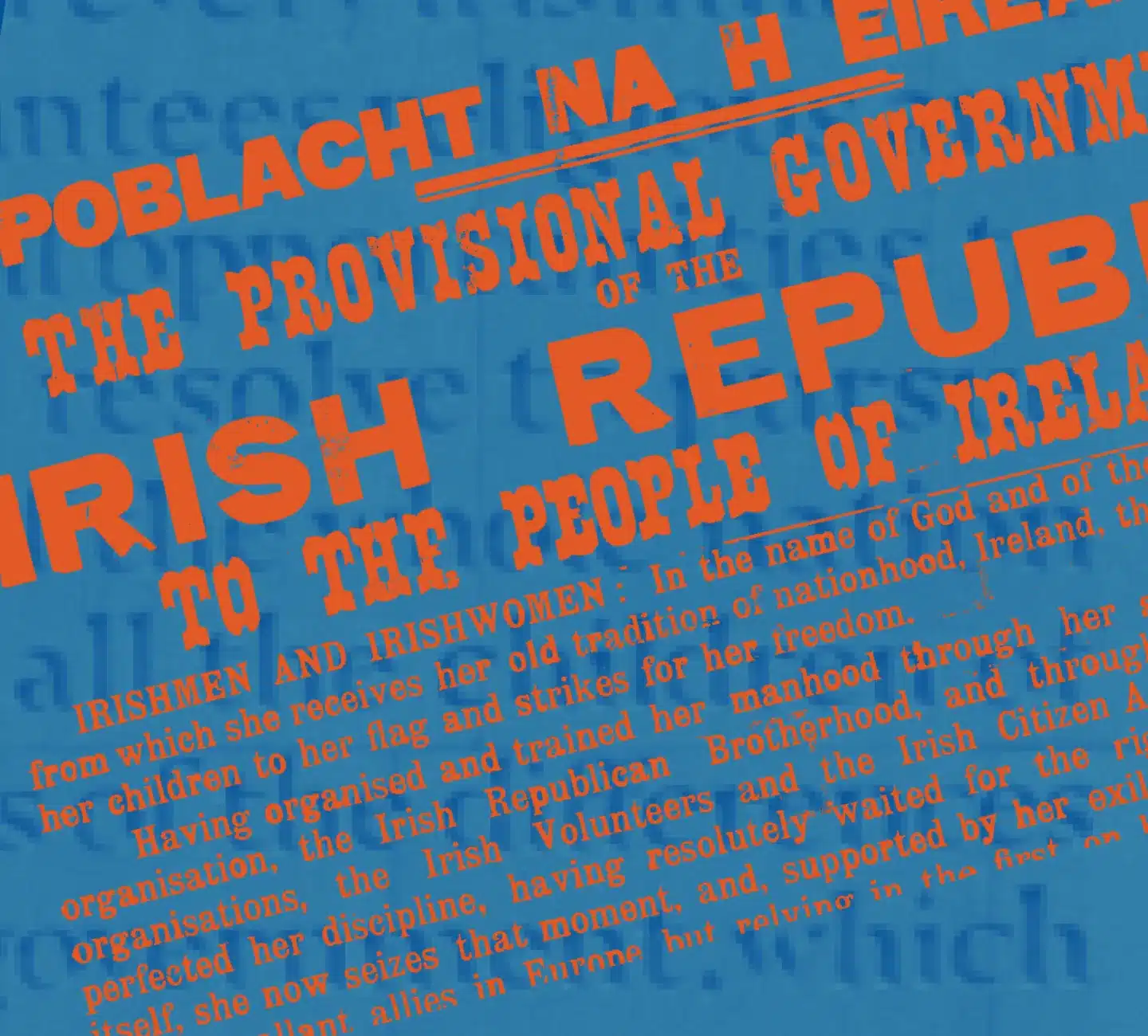
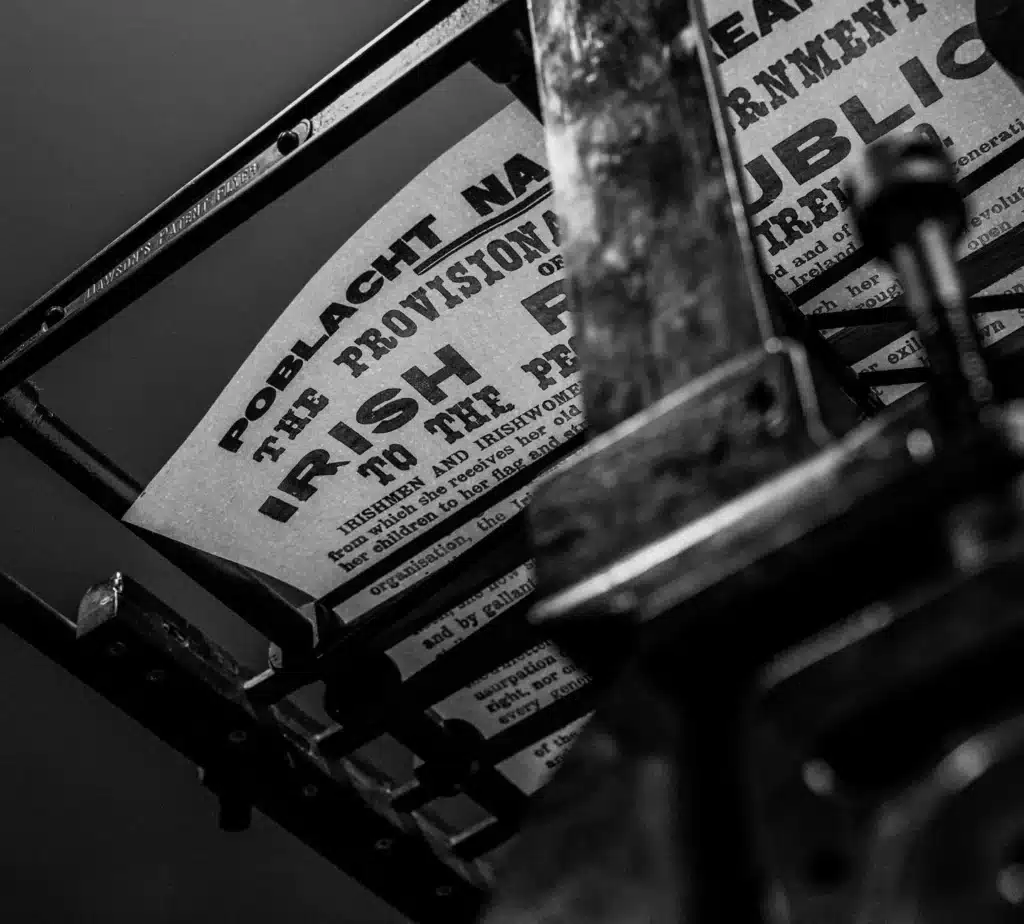
As rebels seized the centre of Dublin on Easter Monday 1916, they declared an Irish Republic via a printed proclamation which was posted up on walls throughout the city. The 1916 Proclamation has become the foundational document of the Irish State and 110 years later it remains a remarkably progressive document. Addressed to both Irishmen and Irishwomen, it guaranteed ‘religious and civil liberty, equal rights and equal opportunities to all its citizens’. It went on to ‘declare its resolve to pursue the happiness and prosperity of the whole nation and of all its parts, cherishing all the children of the nation equally’. For over a century, the 1916 Proclamation has been an inspiration and a guiding star for Irish society. It has also held the nation to account when it has fallen short of the promise contained within the words of the Proclamation.
To mark the 110th anniversary of the 1916 Proclamation and the National Print Museum’s 30th anniversary, the Museum has commissioned seven contemporary artists to create new print-based works responding to the Proclamation and its relevance in contemporary Ireland. These works reflect both its history and the ways in which it can help us to shape our future.
Shane O’Driscoll
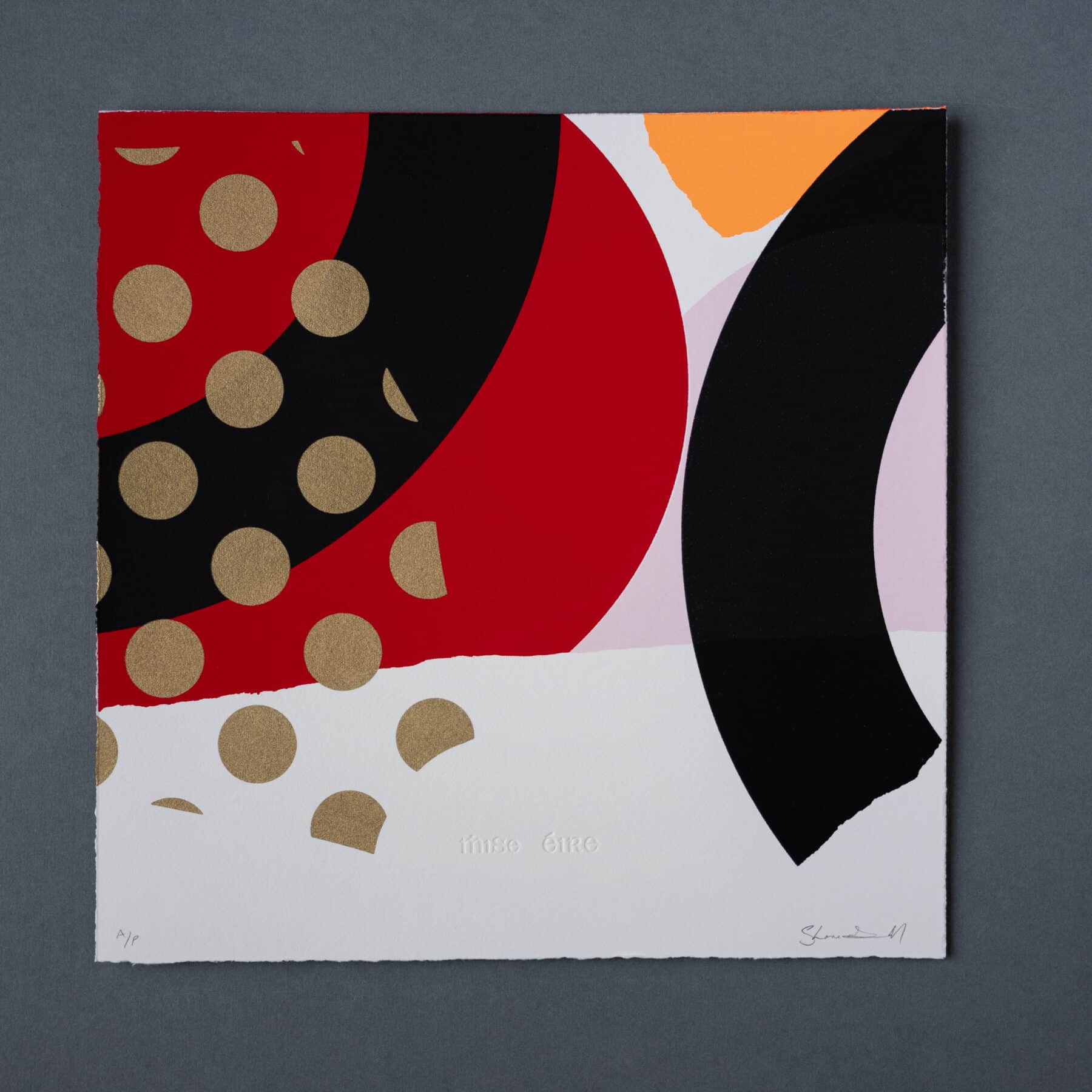
Mise Éire
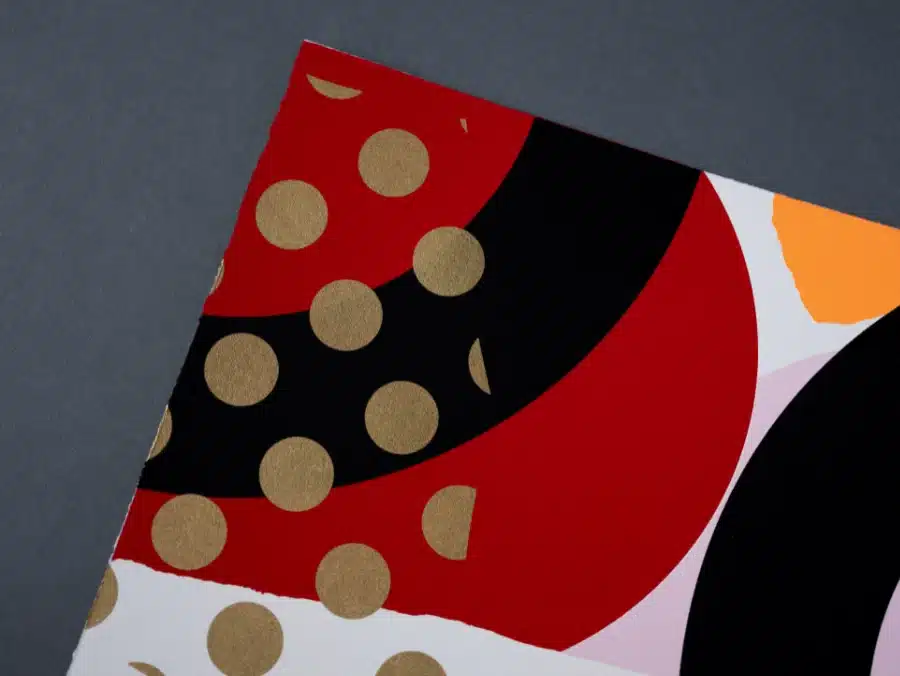
Grounded in architectural elements of Liberty Hall, the GPO and the cylindrical forms of the Wharfdale printing press, the print represents an abstracted response to brief.
Many anomalies resulted from a shortage of specific letters when the Proclamation was hastily typeset at Liberty Hall. The rough-edged black curve on the print references the irregular letter “C” in Republic in the Proclamation, originally an “O” filled with wax. Since first learning about its production at the Print Museum many years ago, I have been fascinated by these imperfections, which reveal the urgency and resourcefulness behind its creation.
Three signatories were published poets, and I wanted to acknowledge this literary dimension through the words Mise Éire (“I am Ireland”), the title of Pádraig Pearse’s 1912 poem. Expressing national identity and resistance, the poem connected the Gaelic cultural revival with the struggle for independence and continues to resonate across Irish literature and art.
“Mise Éire” is blind debossed using irregular typography, shaped by the limitations of the type available to me. This process deliberately echoes the constraints experienced by the original printers, allowing the physical act of making to reflect the history being commemorated. The debossed lettering gives the words a tangible presence, while the irregular forms and rough edges translate the Proclamation’s printing anomalies into an abstract visual language.
Through these material and formal references, the artwork moves beyond literal representation to explore the relationship between language, history and making. The imperfections are not concealed but embraced as meaningful traces of the original document’s production.
Shane O’Driscoll
Shane O’Driscoll is a visual artist based in West Cork. Working primarily in screen printing, murals and mixed media, his practice explores the relationship between colour, geometry, texture and form. Drawing inspiration from architecture and the surrounding landscape, Shane creates bold, contemporary compositions that balance simplicity with visual energy and movement.
A graduate of Visual Communications at Cork Institute of Technology, Shane is a member of Cork Printmakers and Backwater Artists Group, and a co-director of Cork’s Ardú Street Art Project. He has exhibited widely in Ireland and internationally, and his work is held in the permanent collections of the National Gallery of Ireland, Crawford Art Gallery, Trinity College Dublin and University College Cork, among others. In 2024, he represented Team Ireland as an Artist in Residence at the Centre Culturel Irlandais during the Paris Olympic Games.
Ellen Martin-Friel
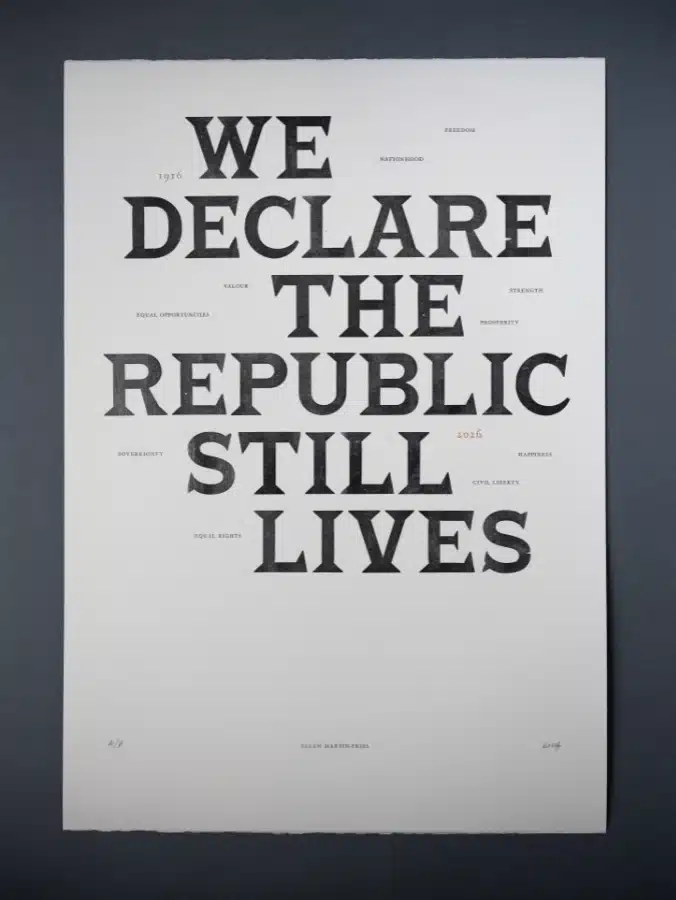
We Declare the Republic Still Lives
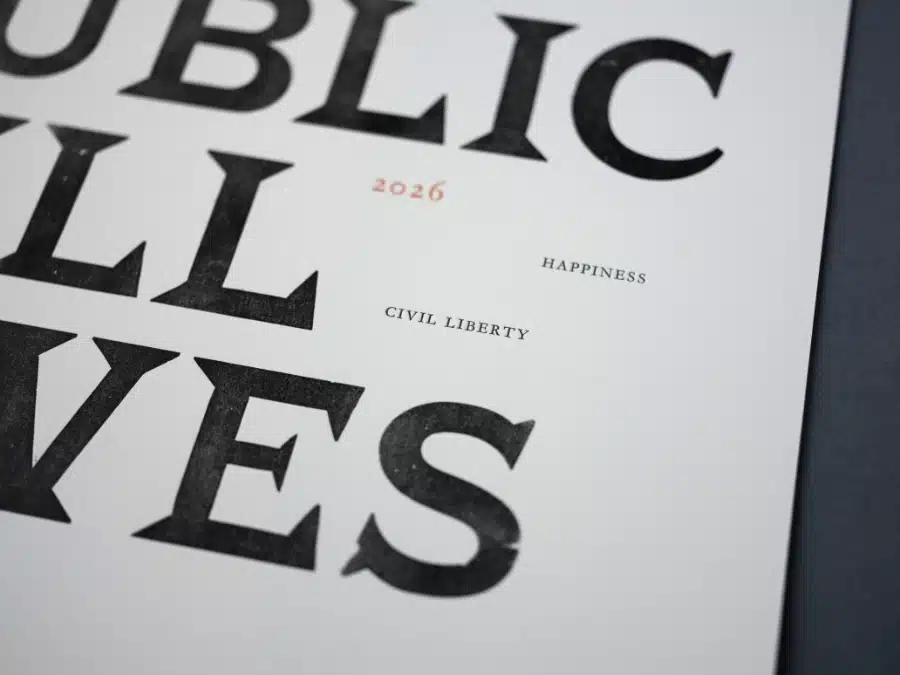
We Declare the Republic Still Lives examines the guarantees made in the Proclamation to the people of Ireland; a sense of nationhood, freedom, civil liberty, sovereignty, equal rights, equal opportunity, a promise of happiness and prosperity. 110 years on, we can reflect on which promises have been upheld and how we must continue to work towards keeping these ideals alive as our nation and the world around us evolves.
At a time when democracy is increasingly under attack globally and questions of borders, ownership and governance become urgent, we must boldly declare our rights and use our collective voice to articulate what we expect our republic to stand for. We must reflect on our nation’s place in the world, its position within the EU, and look at how we respond to the ongoing destruction around us. As a nation shaped by a struggle for independence and sovereignty, we have a responsibility to consider what self-determination means for those denied that same freedom, and how Ireland can use its voice to advocate for peace.
We Declare the Republic Still Lives is both remembrance and dissent; a reflection on the promises made at the dawn of our Republic, a call to consider whether we can be proud of how these values are upheld today, and a question on what we want the future of our nation to look like. It is a declaration that we are committed in our steadfastness to keep our Republic alive.
Ellen Martin-Friel
Ellen Martin-Friel is a book artist, letterpress printer and educator from Dublin. She graduated in 2019 from the National College of Art & Design with a degree in Visual Communication & Critical Cultures, where she now works as letterpress technician and Visiting Lecturer. In her studio practice, Ellen creates and publishes artist’s books made through letterpress and hand-finishing methods. Her work explores the intersection of typography, literature and the printed form, with a considered approach to materiality, an engagement with language and a belief that print remains, and must be preserved as, a vital space for artistic expression and the dissemination of knowledge and culture.
Mary Plunkett
Proclaim
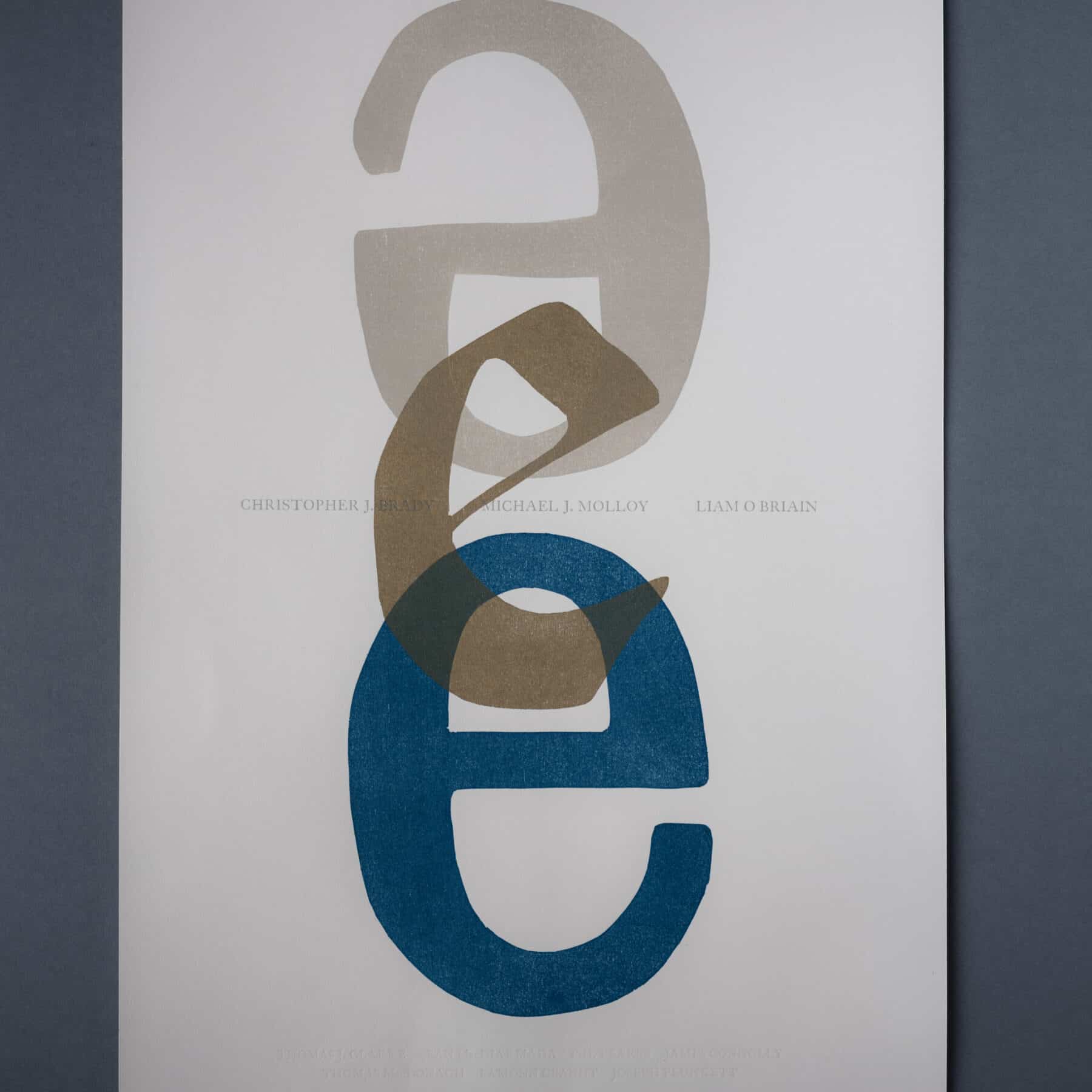
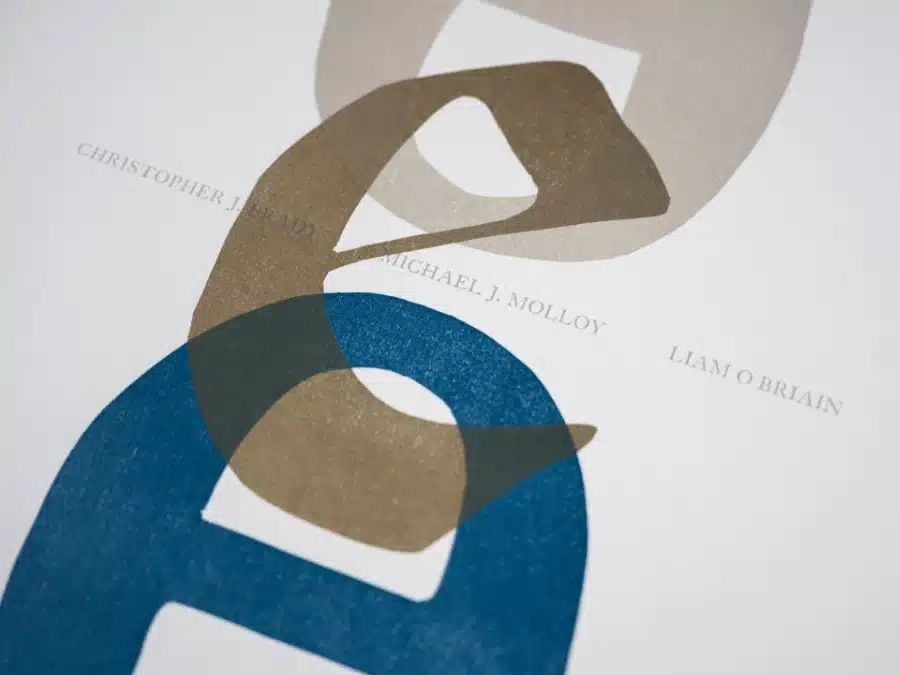
Working with letterpress, I’m particularly interested in the production of the Proclamation and the efforts made to set and print it under unusual conditions. The compositors Michael Molloy and Liam O Briain had a short amount of time, a lack of type and a press that was not in good condition caused a lot of problems for the printer Christopher Brady. They pulled all sorts of tricks to recreate missing letters, and the only actual mistake in the whole document is one upside down ‘e’.
In previous work, I used letterforms as abstract elements and made prints from woodcuts enlarging type beyond usual poster sizes. I revisit this process here, focussing on three treatments of the letter ‘e’ found within the text of the proclamation: the correct, the upside down and the substitute. I wanted to honour the ingenuity of the three men who set and printed the proclamation as well the signatories who put their names to it. While some elements of the print can be seen from across the room, others can only be seen by being up close to the print. As this print is about the making of the proclamation, the compositor and printers’ names are given greater significance by being printed across the centre of the image. The signatories are presented at the base in the same order as used in the original document, ending with the youngest, Joseph Plunkett, my grand uncle.

Mary Plunkett
Mary Plunkett is a graphic designer and printmaker who specialises in letterpress. She designs and prints her own work, in particular book arts, and enjoys collaborating with other artists, writers and designers. Her work is in the collections of the National Library, Trinity College Rare Books, The British Library, Boston College Library, National Irish Visual Arts Library and private collections.
Mary received her MA in Visual Communication from NCAD in 2011, working with letterpress and other printing techniques. She joined Graphic Studio Dublin as a member from 2012 to 2022 and in 2015 set up her own workshop in Rathmines, the Belgrave Private Press. She has taught letterpress courses at the National Print Museum as well as at the National College of Art & Design and in Graphic Studio Dublin.
At the National Print Museum she has collaborated with a number of artists to produce limited edition letterpress printed works, including Anthony Burrill, Maser and Niall McCormack.
She makes limited edition books and prints at her own workshop, the Belgrave Private Press, most recently interpreting three poems in letterpress for the poet Nell Regan and her exhibition, Thirty-Six Views of the Sugarloaf, held at the Mermaid Arts Centre in May 2026.
Sibéal Riordan
A Republic of her Making
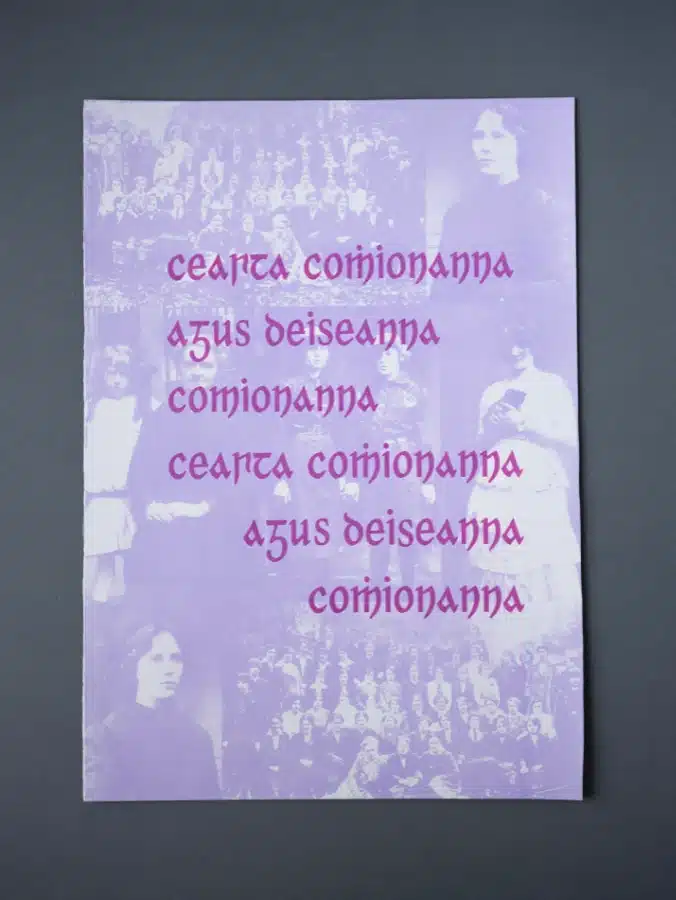
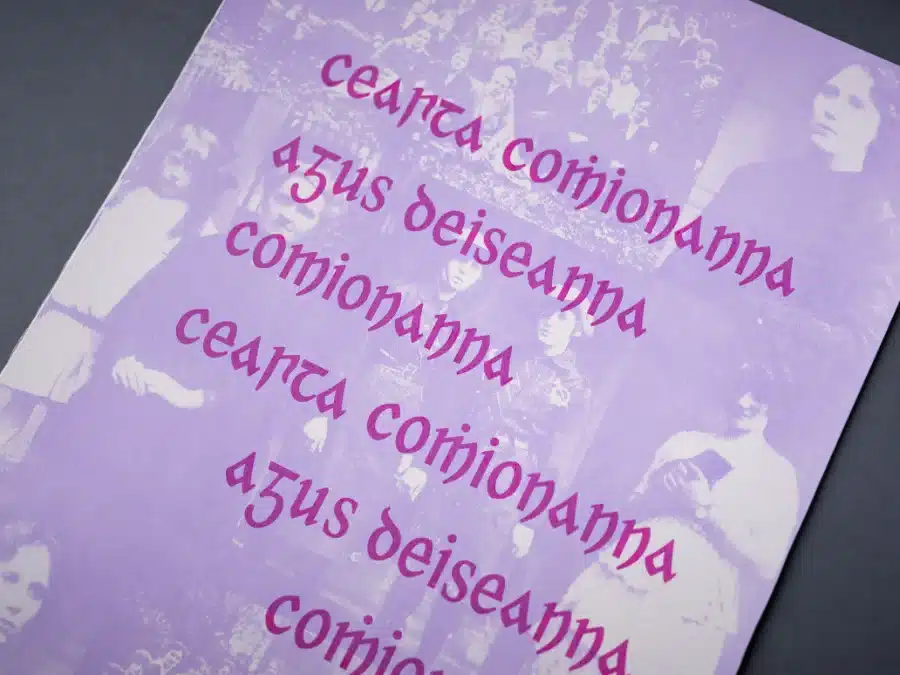
A Republic of her making honours the women whose courage, organising and political determinations shaped the struggle for Irish Independence.
Responding to the 1916 Proclamation, it centres the promise of “equal rights and equal opportunities” and asks how fully that promise has been realised, both in the Ireland that followed, and the Ireland we inhabit today.
The background draws on historical photographs from Kilmainham Gaols archives. Across the photographs the words “Equal rights and equal opportunities” are repeated in Irish.
While celebrating the women who helped imagine a different future for Ireland, the work also acknowledges the inequalities that persisted after independence and continue to shape women’s lives. A republic of her making invites viewers to consider the Proclamation not as a finished promise sealed in 1916, but as a living commitment for which each generation bears responsibility.
Sibéal Riordan
Sibéal Riordan is an Irish artist based in and from Limerick, Ireland. She works mainly through printmaking, in particular silkscreen and letterpress, as well as illustration, photography and collage. Her work is often inspired by Irish history, mythology, feminism and our relationship with nature.
Sibéal has exhibited in national group shows and her work is held in public and private collections across Ireland. She is a member of Limerick Printmakers, where she makes her print-based works, and Spacecraft Studios, where she has been a studio member since 2023.
She holds a BA in Photography, Film & Video and an MA in Social Practice & The Creative Environment from Limerick School of Art & Design.
Alongside her studio practice, Sibéal is active in community art projects and education, teaching workshops in printmaking and mixed media to children and adults.
Viola Chiang
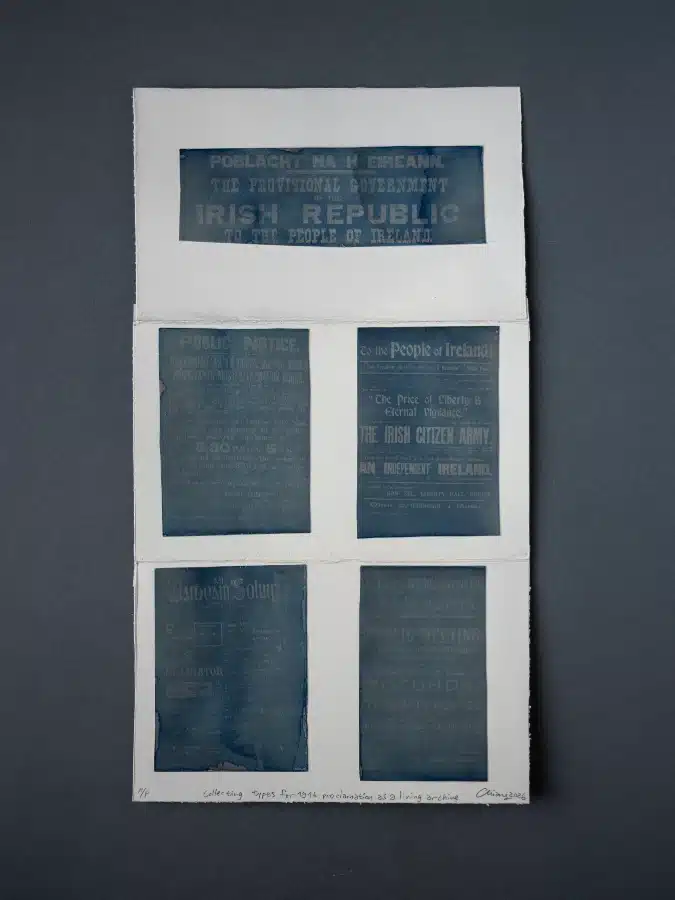
Collecting Types for 1916 Proclamation as a Living Archive
My practice explores between time, space and human interactions with the environment, human histories behind seemingly insignificant objects. The objects (images) appear as unadorned formal arrangements in a print restaging of the interrelationship of material, image, object and time.
The work comes from the language and the rhythm, of the voice, of the action, of time taken to fill a print with marks and moving into a space (book), a print as a poetic space where I can tell stories.
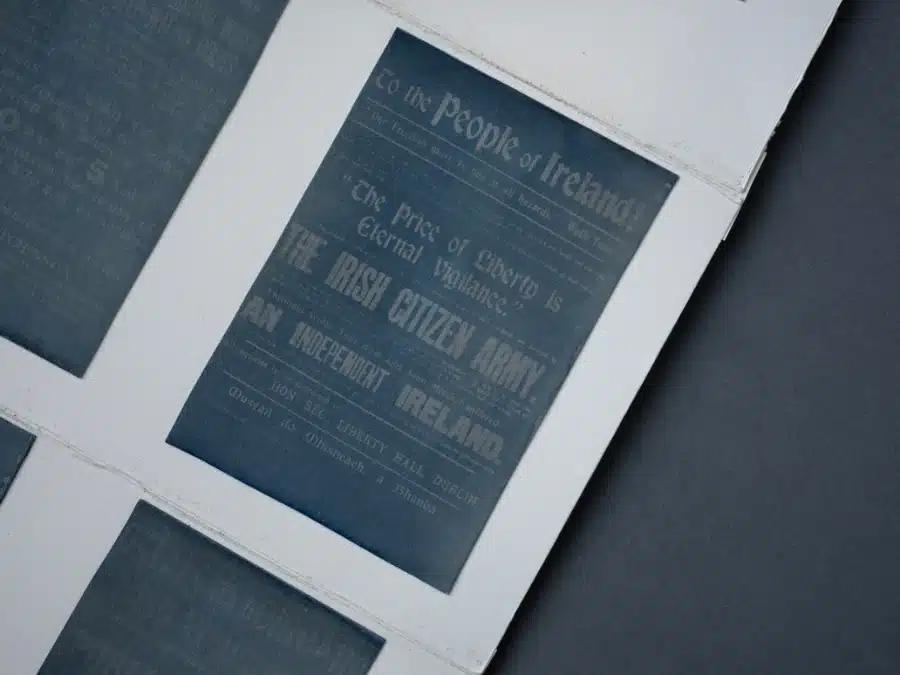
Responding to the 1916 Proclamation in 2026, I focused on Irish type design. I found many different posters, postcards and advertising with particular Irish type design before the rising , during the rising, and after the rising, and I collected them to make an archive to remember this important period in Ireland. As a printmaker, I am always thinking about how to communicate with printmaking, how a word on a poster can catch people’s eyes? A simple, clean design type is the best way to communicate. The print industry in Ireland was very strong and important from the 17th century, and linked to politics. Print as a form, printmaking as a language. In 1916, printers transformed the words of artists, activists, politicians and industrialists into works of permanent ink, which survive today.
For the project responding to the 1916 Proclamation in 2026, I collected different posters, postcards of the rising with different Irish types, printed carefully with cyanotype, and did cyanotype toning, a traditional technique in the 19th century to reuse in our time, each print as a living archive, also as documents to spread words to communicate.
Viola Chiang
Tzu Ning Chiang (Viola Chiang), lives and works in Venice, Italy and Dublin, Ireland. She is a Taiwanese multidisciplinary artist whose practice employs a variety of media. She graduated from the Accademia di Belle Arti di Venezia and has undertaken the Erasmus programs in National Academy of Art of Sofia in Bulgaria and LUCA School of Arts in Brussels, Belgium. Member of Black Church Print Studio in Dublin since 2017. Residency in Frans Masereel Centrum in Belgium, Atelier Austmarks, KH Messen in Norway and Cork Printmakers in Ireland. Her work has been exhibited in Italy, Ireland, UK, Greece, Switzerland, Czech Republic, Norway, Austria, Sweden, Bulgaria, Poland, Belgium, Germany, Serbia, Lithuania, Netherlands, Albania and Egypt. In 2022 she started her personal Studio Violatipia in Venice, Italy which is an experimental space where graphic design merges with alternative photography and printmaking.Here, prints, books, publications and works are created on unique, handcrafted, seeking ever new possibilities for artistic expression. Her first official solo show “Book as an object” took place in Linenhall Arts Centre Gallery, Castlebar, County Mayo. Works collected at Office Public Work in Dublin, Ireland and France Embassy in Sofia, Bulgaria.
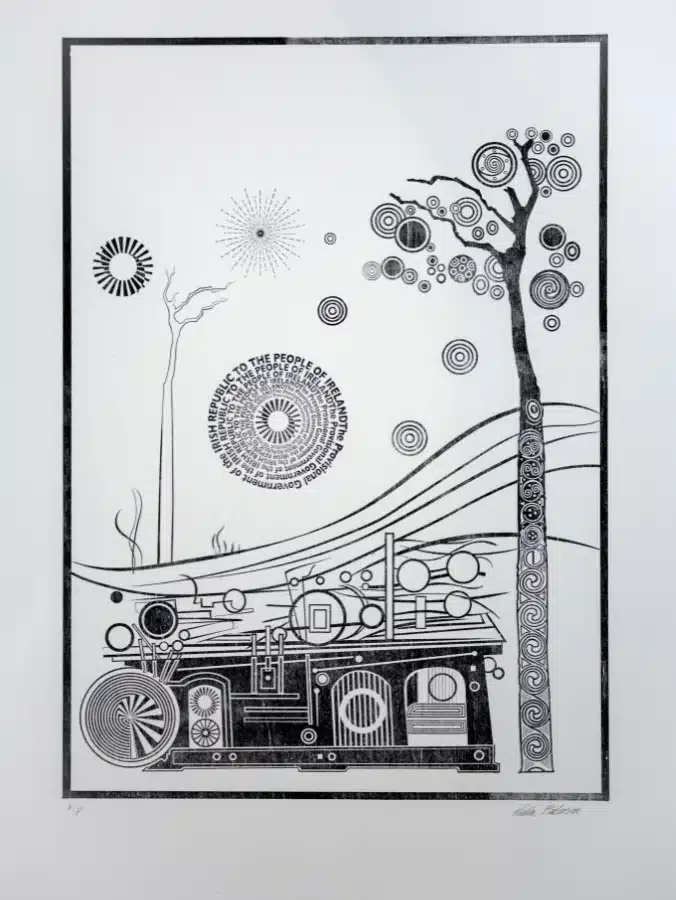
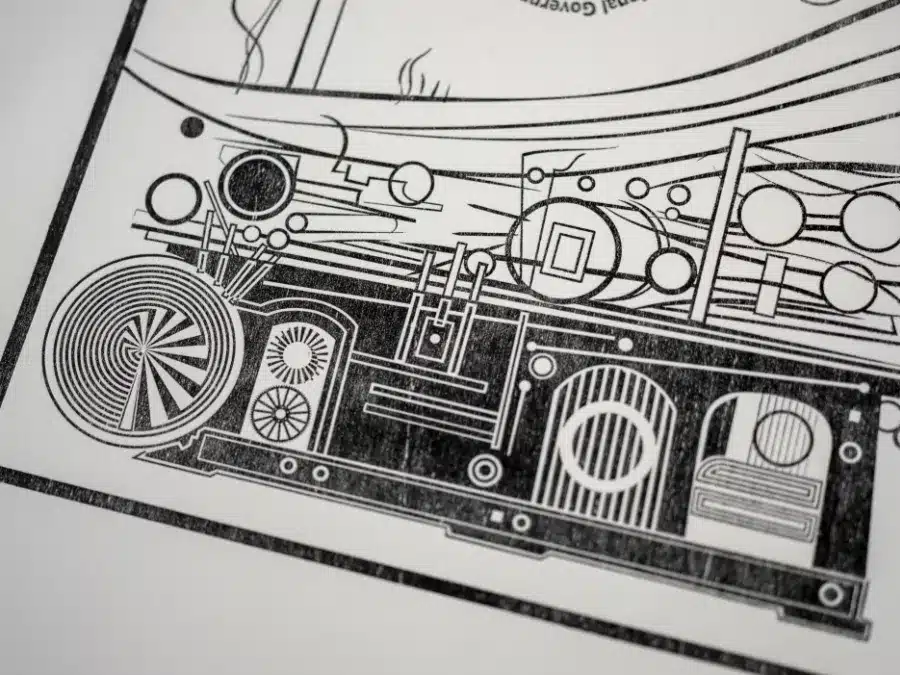
Leila Pedersen
Everything’s Turning, relief print on wood
Leila Pedersen
Lauren Kelly
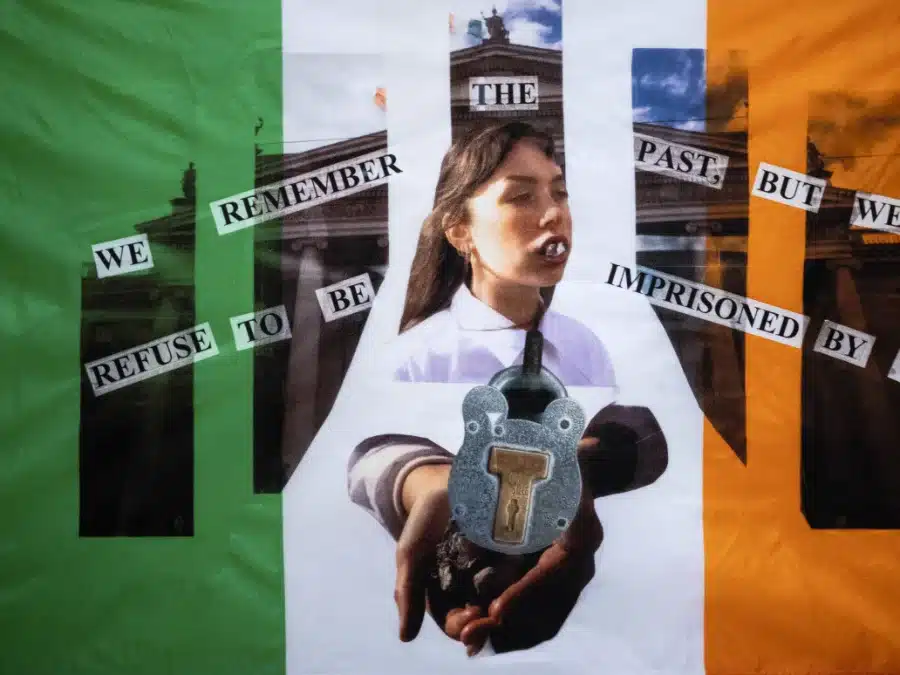
Remembrance and Refusal
We remember the past but refuse to be imprisoned by it.
In Remembrance and Refusal, I layer performance art, sublimation print and textiles to retell the story of the 1916 Proclamation. Printed onto an Irish tricolour, this performative print reclaims the flag from its appropriation by far-right movements, returning to its promise of peace and belonging.
The work recalls Michael Molloy, an Irish Volunteer who fought in the Rising. Imprisoned in Richmond Barracks following the surrender, he chewed up and spat out the paper bearing the seven signatories’ signatures to prevent its discovery by British forces. A declaration of freedom became something to destroy to survive.
I offer another layer to the story: the present. Performing outside the GPO, where the Proclamation was first read aloud, I chew a newspaper reporting the approval of an Orange Order parade. With Ireland still divided, I bring the unfinished promise of the Proclamation into my body, questioning what freedom means while a border continues to cut across the land.
Spitting out the paper marks a gesture of remembrance and refusal. I remember those who resisted while looking towards a country beyond inherited divisions, where belonging is not determined by ancestry or birthplace. Printmaking and performance art meet in an embodied retelling of resistance. Past, present and future move through one performative print, a flag that refuses division, holding the possibility of a new Ireland, Éire Nua, together by equality, freedom and care for all who call it home.
Lauren Kelly
Lauren is an award-winning visual artist based in Dublin, working primarily in performance. She is the founder of the Performing Activism Collective and works both independently and through socially engaged collaborations. Her practice is a form of activism, using embodied performance to express political realities and explore oppression.
Lauren’s work engages directly with political and historical contexts, including women’s healthcare and the occupation of public and institutional spaces. With the Performing Activism Collective, she has performed at Leinster House, bringing work on women’s healthcare into a political setting. She has also performed at historic sites such as Kilmainham Gaol, retelling stories of the Cumann na mBan.
Her practice moves between poetic and embodied storytelling, drawing together historical, personal, and political narratives. She collaborates with researchers, archivists, and activists, positioning her work at the intersection of art, inquiry, and social engagement.
Lauren holds a first-class honours MA in Art and Social Action from the National College of Art and Design. She is a former studio resident at Rua Red South Dublin Arts Centre, supported by Create, Creative Ireland SDCC, and Arts and Disability Ireland. Her current concerns engage with contemporary politics, tracing intersections of history, belief, and power. How systems of ideology, religion, nation, and institutions shape experiences of violence, resistance, and collective memor.
Her current concerns engage with contemporary politics, tracing intersections of history, belief, and power. How systems of ideology, religion, nation, and institutions shape experiences of violence, resistance, and collective memor
Acknowledgements
Artists: Shane O’Driscoll, Ellen Martin-Friel, Mary Plunkett, Sibéal Riordan, Viola Chiang, , Leila Pedersen, and Lauren Kelly
Curators: Carla Marrinan Funder, National Print Museum and Brian Crowley, Office of Public Works
Translation: Clare Rowland
Design: Niall McCormack
Printing: McGowans
Production: Ciaran Kavanagh
Framing: Phoenix Framers
Installation: Cameron Brady and Daniel Lordan
Photography: Mark Henderson
Digital Exhibition: Open Design
Special thanks to Dr Aoife Cosgrove, Prof Roisín Higgins, and David Rooney
Supported by the Commemorations Unit of the Department of Culture, Communications and Sport
Download Exhibition poster here
The exhibition opens at the National Print Museum on 13 November and will tour to Kilmainham Gaol in early 2027.
All works are printed in an edition of 30 and are available for pre-order sale online and onsite.

Print Shop
Discover a selection of letterpress prints made at the Museum, or browse through books exploring print and design history.
Print Shop
Discover a selection of letterpress prints made at the Museum, or browse through books exploring print and design history.