Translations by Brian Friel


Brian Friel’s Translations seeks to explore the impact of British colonisation on Irish culture and identity. Through this piece of theatre, Friel invites the audience to consider the importance and value that language can have in shaping identities. This is achieved through tension between characters who speak Irish and cannot understand those who speak English. However, the production is performed completely in English, emphasising the importance of language to the audience. In preparation for a 2022 production of Translations also in the Abbey Theatre, the theatre discussed the play’s lasting legacy and relevancy. They connected the 2022 showing of the play to the centenary of the Anglo-Irish Treaty in 1921 (the treaty partitioned the island of Ireland, formulating Northern Ireland and the Republic of Ireland). The Abbey Theatre also remarked that ‘Friel’s modern masterpiece finds a new potency, in a time where Brexit has thrown current Anglo-Irish relations into sharp relief, redrawing old boundaries and opening up old wounds’. This particular run was clearly facilitated to provoke audiences to truly consider the impact that both the historical 1921 treaty and Brexit has had on conceptualisations of Irish identity and the island of Ireland’s relationship with Britain. The emphasis on the Irish language also speaks to current society, which is experiencing almost a renaissance when it comes to the Irish language and culture. Thanks in part to the Irish rap group, Kneecap, and social media trends popularising heritage items such as the claddagh ring, the Irish language and cultural heritage has been brought to a global audience. As a result, there has been rising interest in learning the Irish language and a growing consideration for what it means to be Irish in today’s world. Theatre can also be an important aspect of this conversation by going beyond a fictional avenue for entertainment and escape to a place where critical reflection about society can occur.
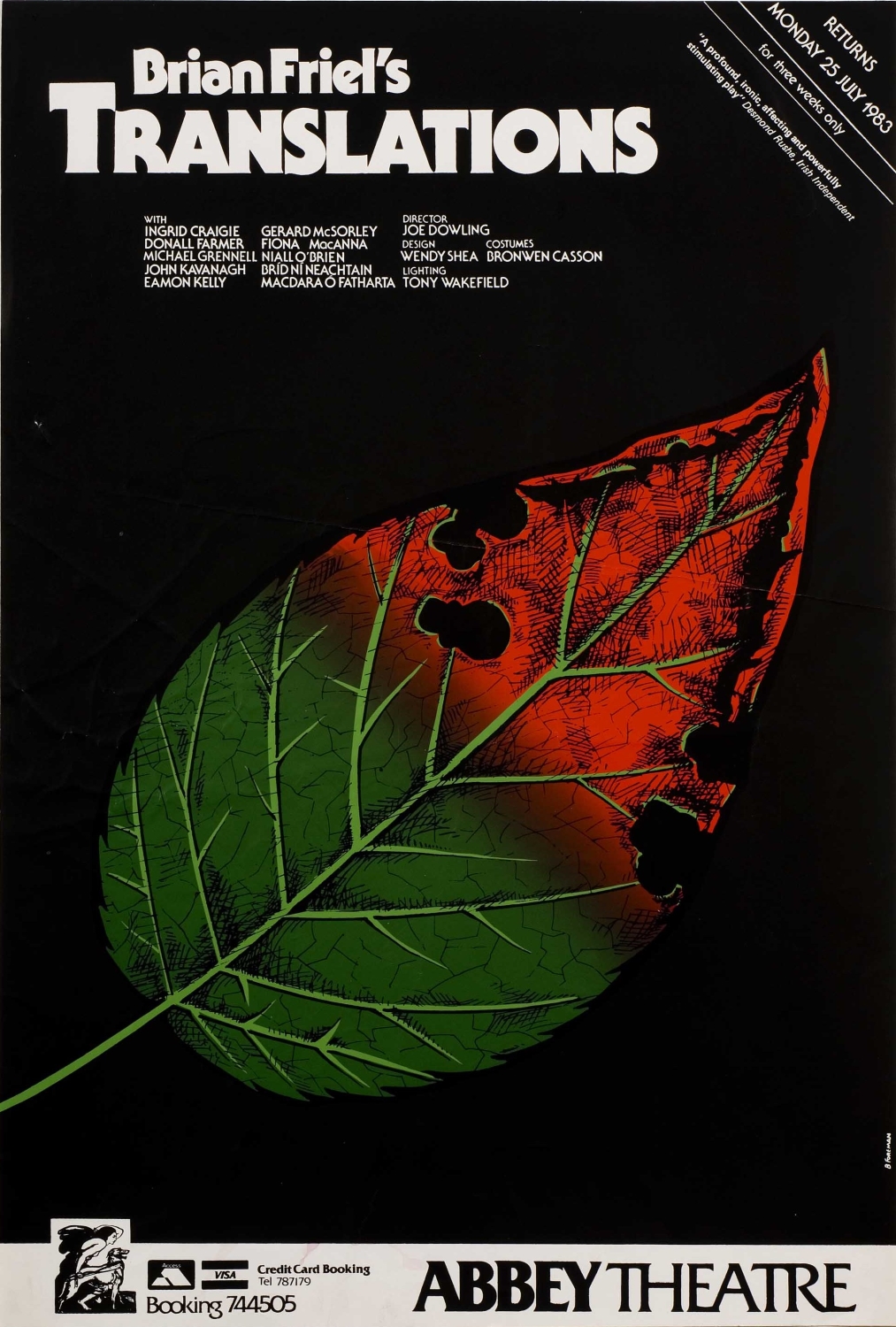
The poster discussed here was designed by Brendan Foreman for a 1983 production run of Translations in the Abbey Theatre. The poster can be used to explore how the themes of Translations applied to Irish audiences in the 1980s, a time of political turmoil due to the Troubles conflict in Northern Ireland at the time. It is clear that Friel crafted the play with these political questions in mind. In an interview with Fintan O’Toole in 1982, Friel reflected how he believed that the political problem of the island of Ireland was ‘going to be solved by language in some kind of way’. He stated that this was ‘not only the language of negotiations across the table’ but also ‘the recognition of what language means for us on this island’. The poster prominently features a decaying leaf, which subtly informs the play’s overarching theme: the decay of the Irish language. The imagery of decay might imply that the loss of the Irish language would have a negative impact on Irish culture. It does this through the use of the colour red, which can be quite intense. The green on the other half of the leaf indicates positivity, suggesting that there is still time to save the language. The poster effectively communicates the themes of the play in a manner applicable to the political questions Friel was grappling with. Through this theatre poster, we can now gain a unique glimpse into how society dealt with politics in their daily lives.
Prior to the 1970s, posters advertising plays at the Abbey Theatre were more text-based. Kevin Scally and Brendan Foreman were incredibly influential in facilitating the move towards more art-based posters. The poster for Translations is an excellent example of this. Foreman did a beautiful job of conveying the themes of the play in a way that has stood the test of time, allowing us to gain a modern glimpse into Irish society in the 1980s.
By Niamh O’Donnell, researched and written for #OpentheArchives, 2025.